Rule workflow with approvals
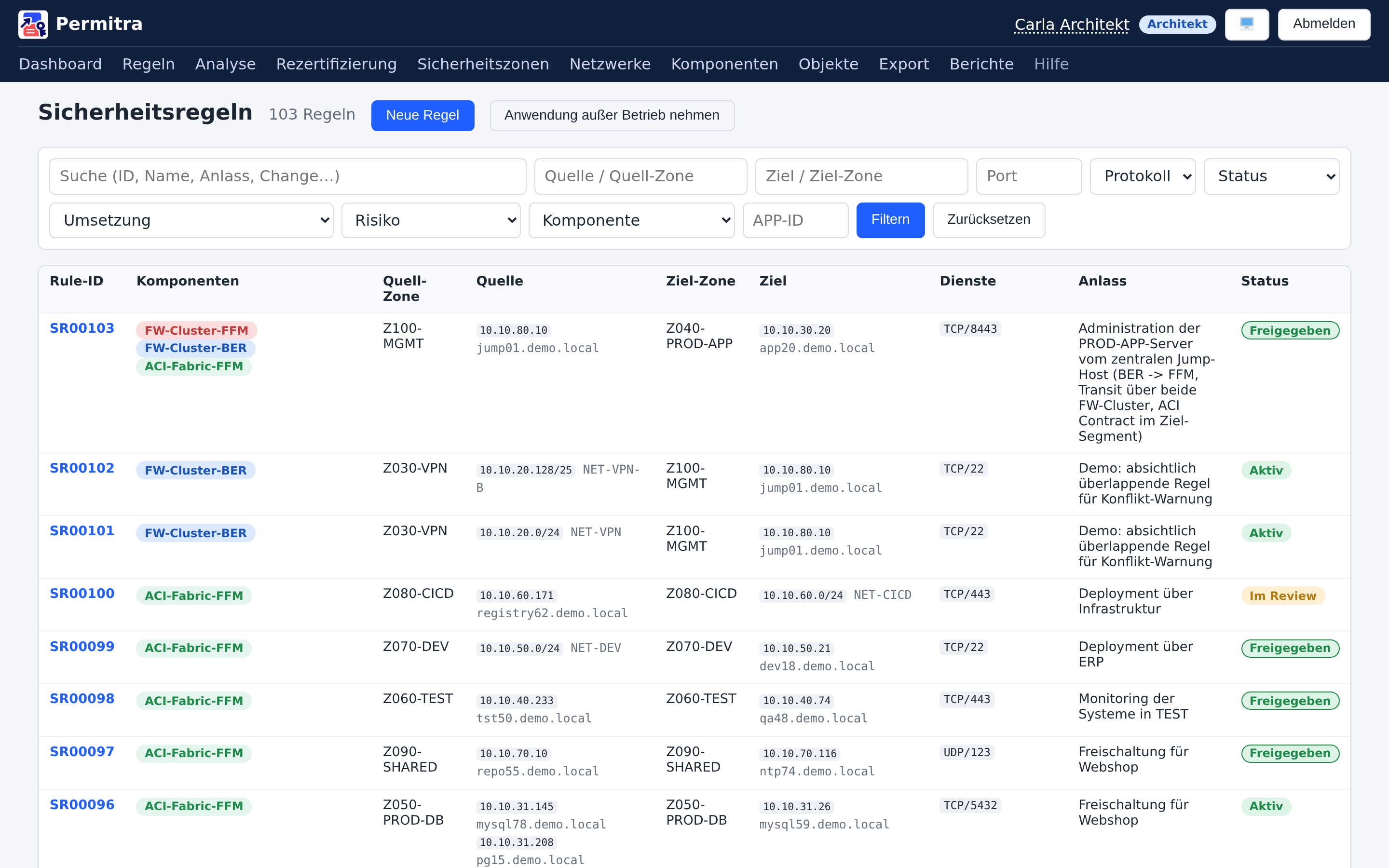
Unique rule IDs, draft → in review → approved → active, where
“active” only applies once operations has confirmed the rollout on every component.
Version history, comments, recertification of expiring rules. Nothing is ever
deleted: a rule that is no longer needed gets the status “deleted” and stays
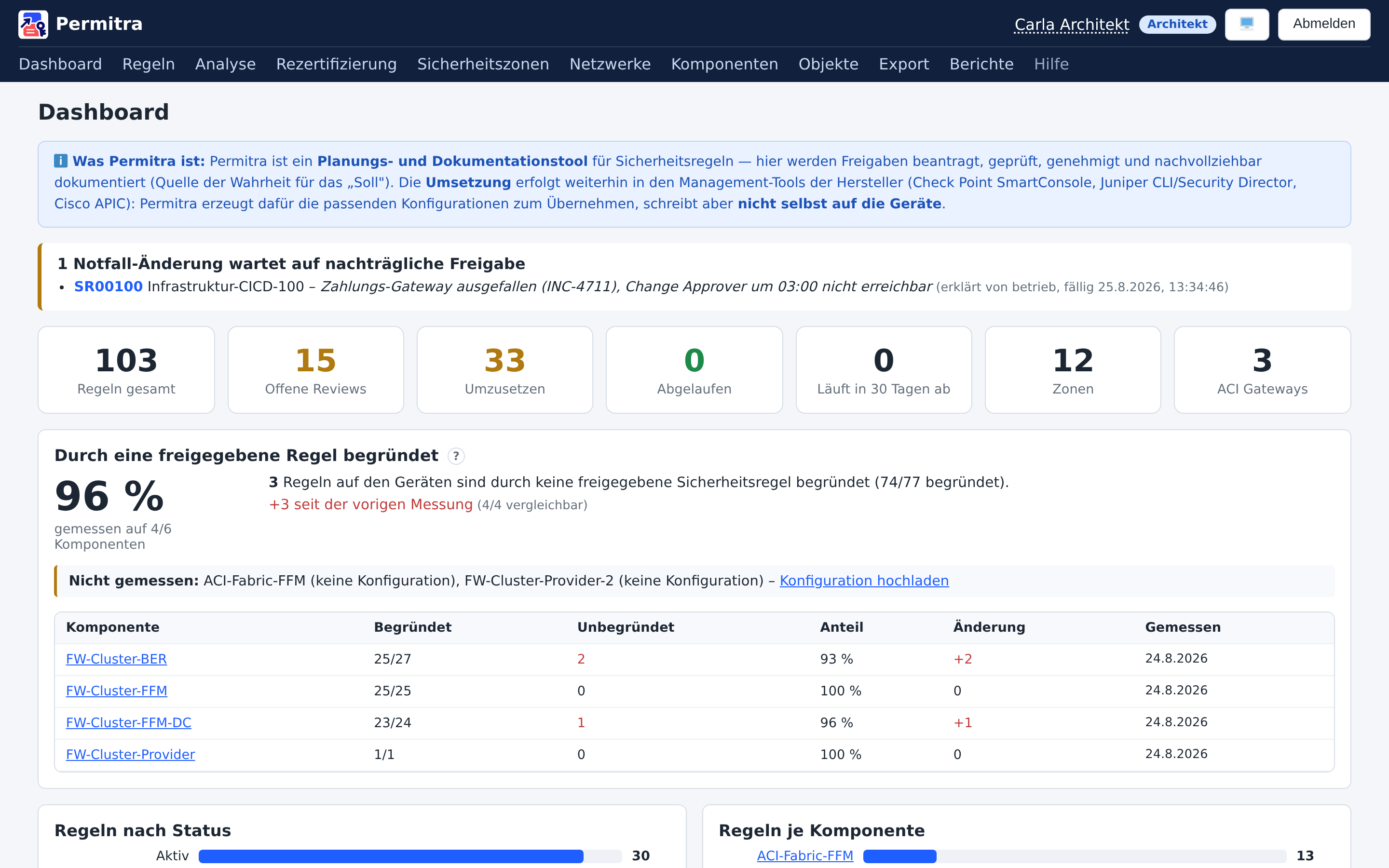
visible. The three-in-the-morning case has its own deliberately narrow path:
the rule already in place is documented afterwards and expires by itself
without an approval.
Security zones (BSI model)
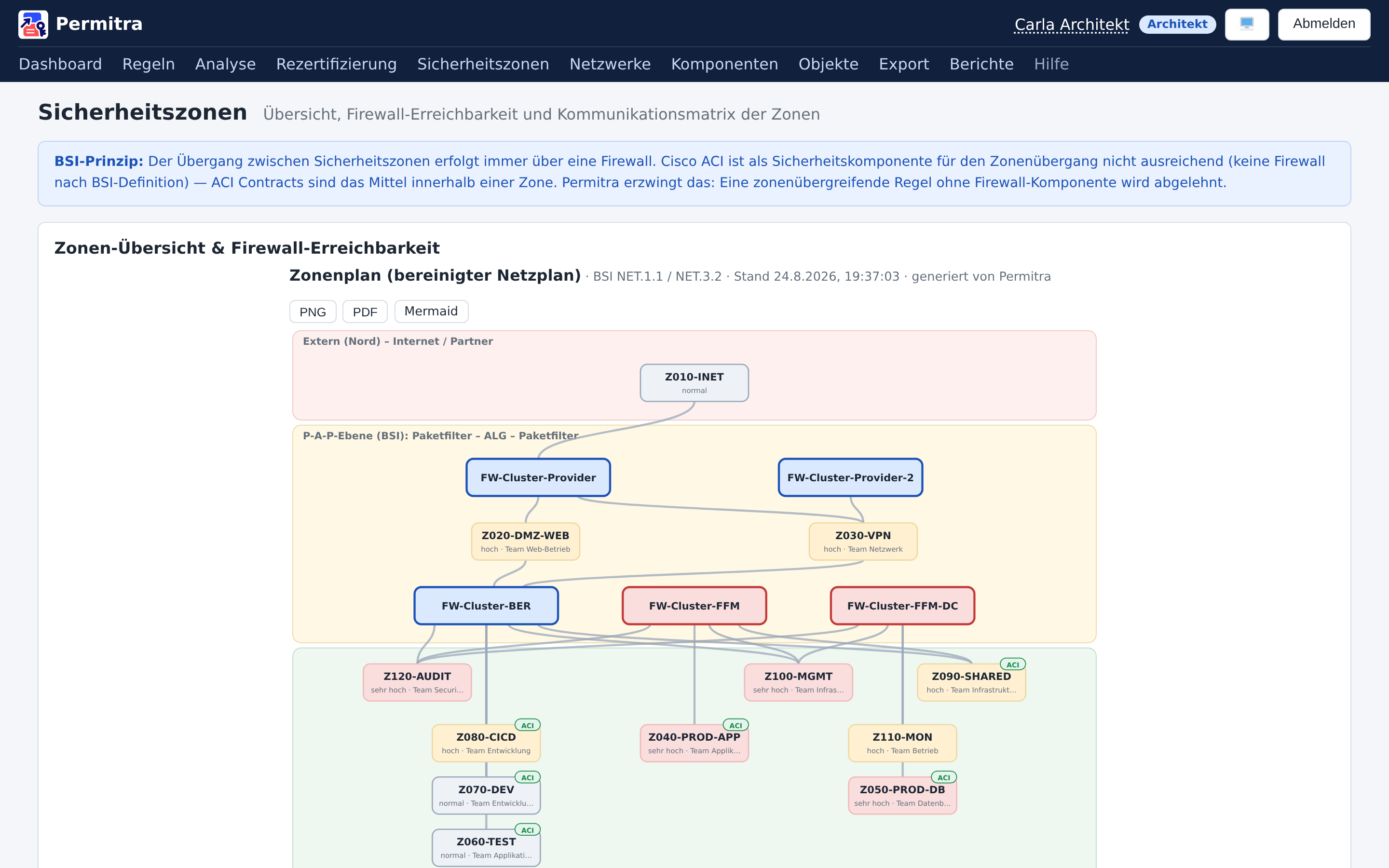
Zone communication matrix (allow/block) with the P-A-P model: zone
transitions always cross a firewall, ACI only applies within a zone.
Matrix changes require two approvals.
Network registry
Every network belongs to exactly one zone. Source and destination zones
of a rule are derived automatically from its addresses – mapping changes go through
the approval workflow.
Automatic component resolution
From source and destination, Permitra determines on which firewall
clusters or ACI fabrics a rule must be implemented – including an implementation
status for operations.
Practical exports
Juniper SRX set commands, Check Point mgmt_cli and Management API,
Cisco ACI contracts (EPG-based, incl. PBR service graphs), host firewalls
(nftables, firewalld, iptables), CSV and JSON. The built-in Capirca/Aerleon
integration adds Cisco IOS/ASA, Palo Alto, zone-based SRX and iptables –
or Capirca policy YAML for existing pipelines.
Analysis & drift
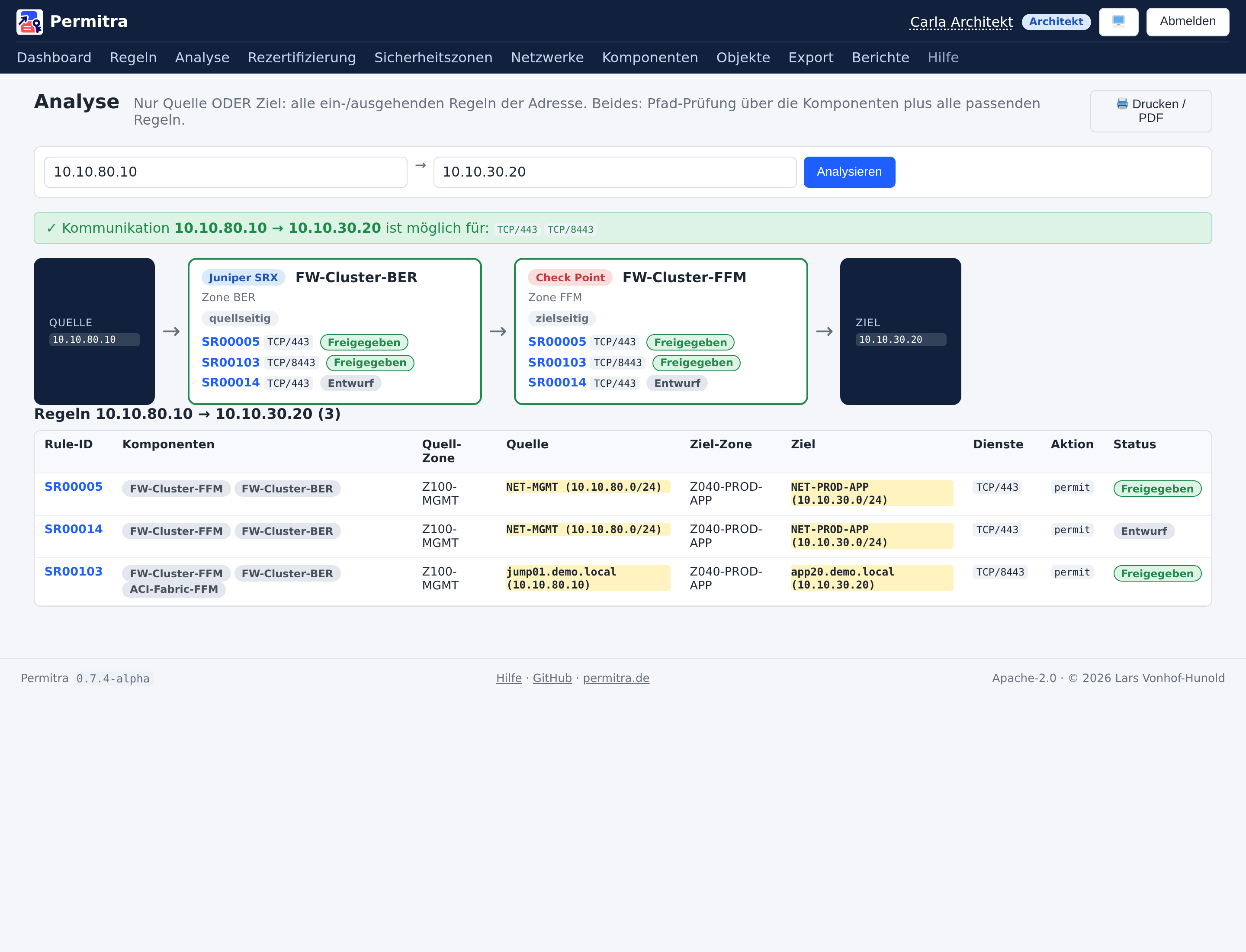
Address search and path analysis: the route is derived from the documented
links between the firewalls – several firewalls in a row is the normal case in an enterprise.
Where there is no way through, the analysis says so; where there are two redundant ones it shows
both, because a rule on only one of them holds until the failover. Plus
conflict and risk warnings, and drift comparison against uploaded device configurations.
The comparison answers both directions: did my rules arrive – and conversely, is every rule
on the device backed by an approved security rule? And it checks that the rule on the device
permits only what was approved.
Per-application reports
Every rule carries an APP-ID; from it you can generate a CSV report of all rules
for an application – handy for audits and application reviews.
Tamper-evident logging & SIEM
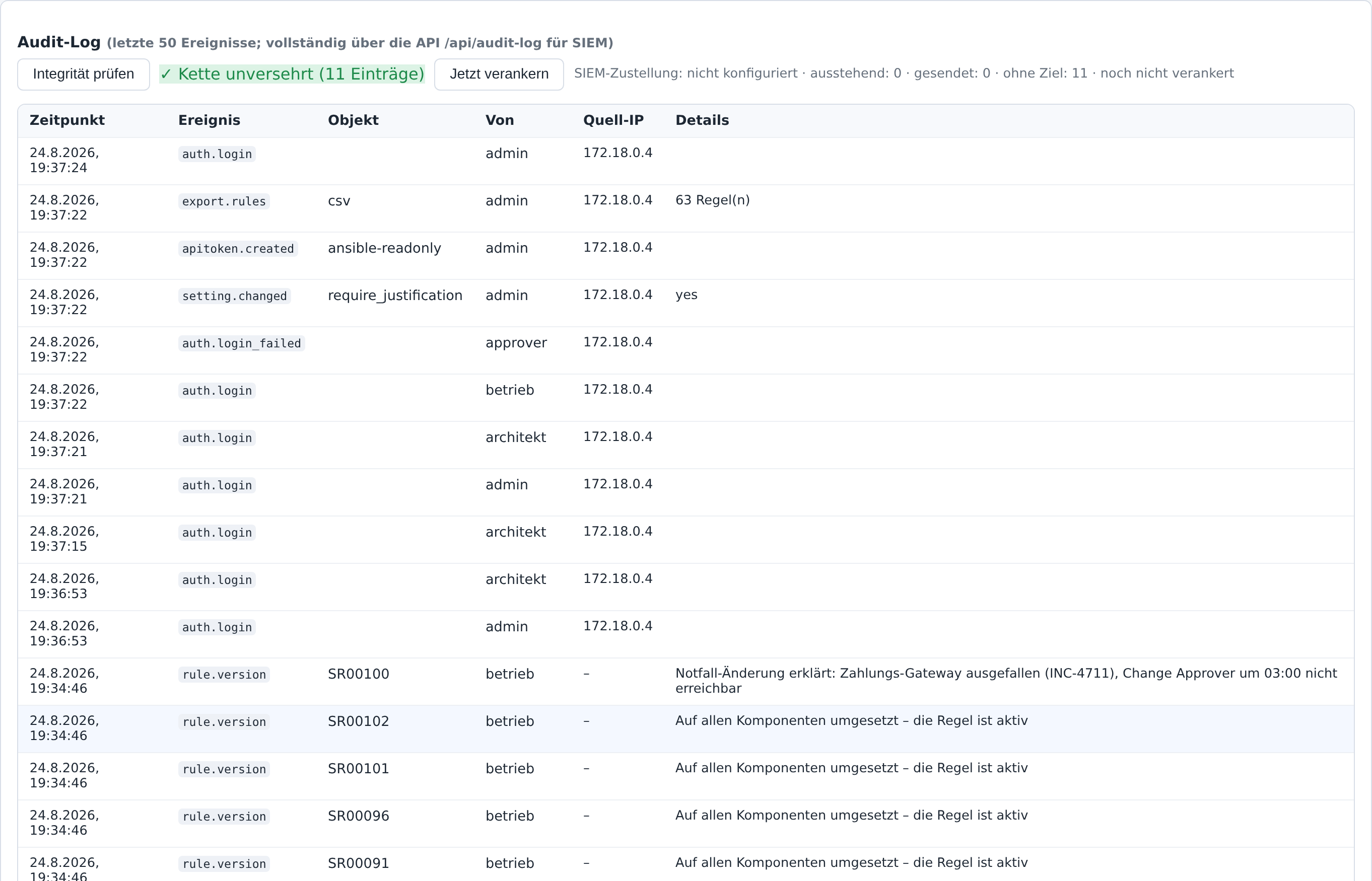
Sign-in, admin and access events are logged append-only with source IP and secured
against tampering by a SHA-256 hash chain – any later change stands out, even one made
directly in the database. Delivery to a SIEM is reliable (at-least-once) and survives
restarts as well as outages.
Automation: API & NetBox
Read-only API tokens connect Ansible/Terraform; network prefixes import
directly from NetBox (preview before commit). Authentication with 2FA/passkeys
and login lockout.
 Permitra